
Home of Electronics
Electronics retail, pre-orders & in-store pickup. A Nairobi electronics platform for online shopping, paid pre-orders, and in-store collection — connecting the digital storefront directly to physical fulfilment.
Overview
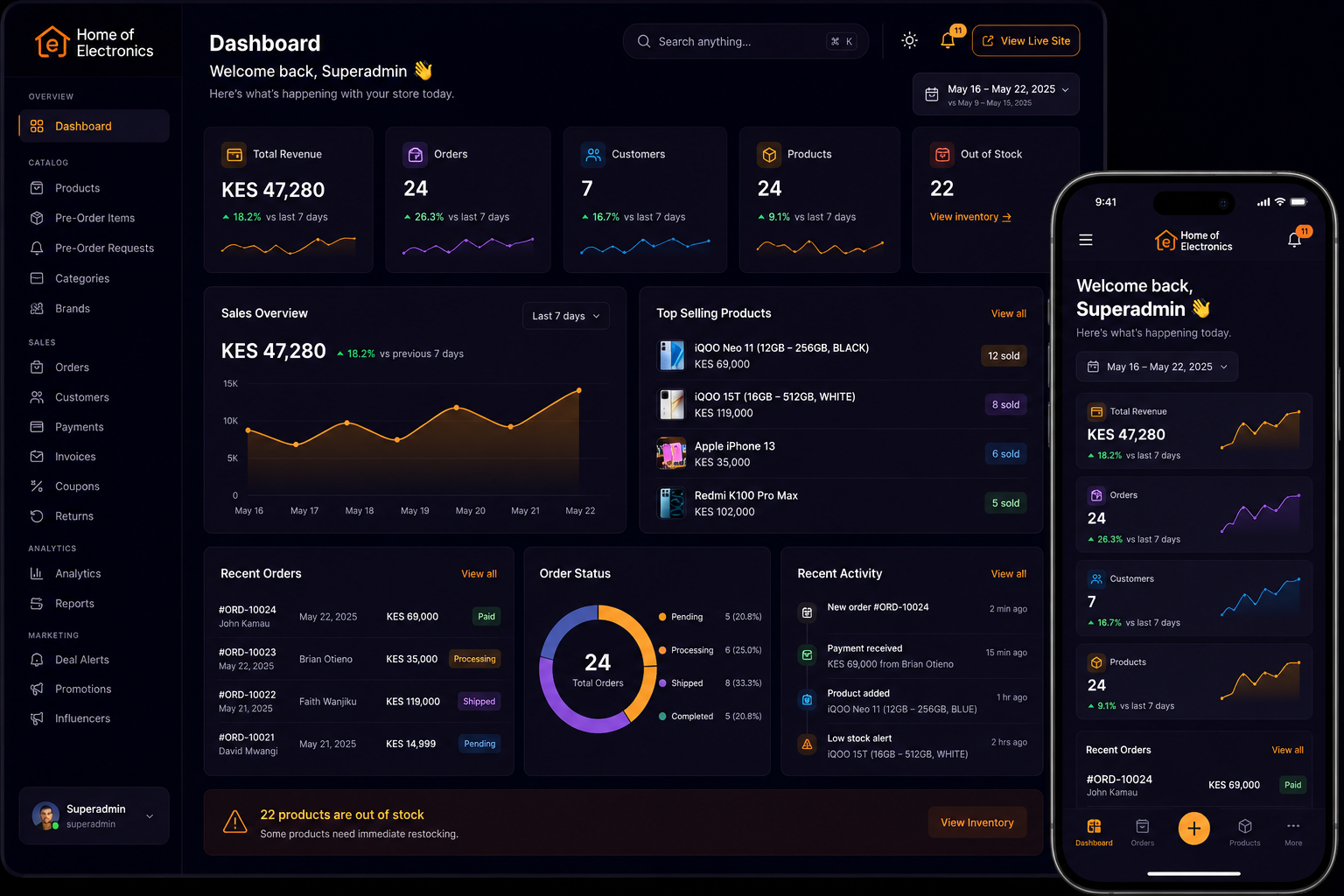
Home of Electronics is a live electronics retail platform at homeofelectronics.com. It connects online browsing, customer accounts, payments, pre-orders, order tracking, and physical collection at the Nairobi store. For pre-order products, customers can reserve a device by paying the required deposit instead of paying the full price upfront.
The Problem
Selling available stock online was straightforward, but pre-orders were much harder. Customers needed a reliable way to reserve upcoming devices, pay the required percentage upfront, and have that payment tied to a specific order without relying on manual conversations and payment confirmation.
The Approach
Treat the website as more than a catalogue. It coordinates the commercial workflow between the customer and the physical shop — from product availability and pre-order configuration through payment, reservation, order state, and final collection.
System / Product Design
The platform separates regular purchases from pre-order workflows while keeping them within the same commerce system. Products can define pre-order requirements, including the percentage payable upfront. Integrated payment rails handle the deposit, while the resulting transaction and order reference connect the customer's online reservation to fulfilment at the physical store.
Technology
Web · E-commerce · Payments · Pre-orders
Challenges
Making pre-orders reliable
Pre-orders were previously difficult to coordinate manually. The system needed to know which products could be pre-ordered, how much a customer had to pay upfront, whether that payment succeeded, and which reservation the payment belonged to.
Partial payment workflows
A pre-order is not a normal checkout. Customers pay a specified percentage of the gadget price upfront, so the system has to distinguish the deposit from the full product price and preserve the remaining balance against the order.
Payments and order state
Payment initiation alone is not enough. A reservation should only progress when the payment rail confirms the transaction, requiring payment status and order status to remain synchronized.
Online catalogue, physical stock
What is presented online has to remain aligned with what can actually be fulfilled at the shop, especially when available stock and incoming pre-order inventory follow different timelines.
Pickup, not delivery
The platform supports a physical retail operation rather than trying to become a courier network. The customer journey therefore needs to make collection and order identification clear.
Key Decisions
Configurable pre-order deposits
Instead of hard-coding one deposit amount, pre-order products can define the percentage of the gadget price that a customer must pay to secure the reservation.
Integrate payment rails into the reservation flow
Pre-order payments happen inside the product workflow so successful transactions can be associated directly with the customer, product, amount paid, and resulting order.
Separate payment from order state
A payment attempt and a confirmed reservation are different events. Keeping their states explicit makes failed, pending, and successful transactions easier to handle safely.
Pickup with a tracking ID
Collection remains the fulfilment model. The tracking ID connects the customer's digital order to the physical collection process at the store.
Accounts for repeat customers
Customer accounts keep purchases, pre-orders, payments, and tracking information attached to the customer rather than disappearing after a one-off checkout.
Outcome
Home of Electronics is live as a digital extension of the Nairobi electronics store, supporting regular online purchases as well as paid pre-orders. Customers can reserve upcoming devices by paying the required deposit through integrated payment rails and later complete fulfilment through the physical shop.
What I Learned
- Pre-orders are a financial workflow, not simply another product status.
- Partial payments require payment state and order state to be modelled separately.
- Payment confirmation should drive reservation state rather than trusting checkout completion alone.
- A local shop selling online still needs a clear contract between digital ordering and physical fulfilment.
- The website is only useful when product availability, payments, reservations, and collection stay in sync.